Choosing the right material handling equipment can be challenging. Many companies face the question: how to choose between a vertical lift and an inclined conveyor? According to industry expert John Simmons, “Understanding your operational needs is key to making the best choice.”
Vertical lifts are ideal for transporting items between different floors. They work well in applications where space is limited. On the other hand, inclined conveyors are designed for continuous transport at an angle. They are often used in warehouses and assembly lines.
Selecting the right system depends on numerous factors. Consider the types of materials you are moving. Will they be bulky or fragile? The vertical lift may be more forgiving with various load types. However, the inclined conveyor can optimize floor space. Reflect on your workflow and available space. Each conveyor type has specific benefits and challenges. Balancing these will help you make an informed decision.
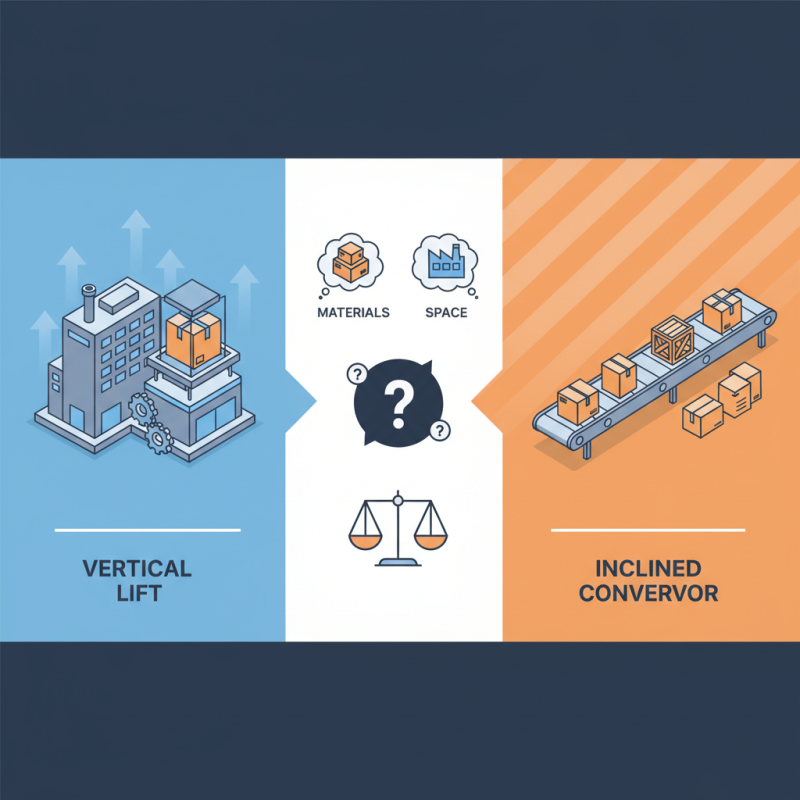
Understanding the Basics of Vertical Lifts and Inclined Conveyors
When considering the movement of materials, the choice between
vertical lifts and
inclined conveyors is crucial.
Vertical lifts, known for their efficient use of vertical space, excel in moving items straight up or down.
They are ideal for compact environments, minimizing the floor footprint.
According to industry reports, vertical lifts can enhance operational efficiency by up to 30% in warehouse settings.
Image Placeholder
On the other hand, inclined conveyors provide a sloped transport for materials, allowing for a gradual elevation.
They are often more straightforward in design, making them easier to integrate into existing systems.
These conveyors can handle bulk materials and lighter products effectively,
offering flexibility in material handling. In fact, data suggests that inclined conveyors can reduce operational costs by
15% due to lower energy consumption compared to more complex systems.
However, there are trade-offs.
Vertical lifts can be cost-intensive, requiring significant upfront investment.
Maintenance can be challenging as well, given their mechanical complexity.
Inclined conveyors, while simpler, may struggle with certain product types, risking product damage during transport.
Decision-makers must weigh these factors carefully, as even minor errors in selection can lead to increased operational inefficiencies.
Key Differences Between Vertical Lifts and Inclined Conveyors
When deciding between vertical lifts and inclined conveyors, it’s essential to highlight their key differences.
Vertical lifts, designed for moving materials straight up, maximize space efficiency in tight environments. According to a report by the Material Handling Industry of America, an increase of just 10% in space efficiency can lead to significant cost savings. These lifts can handle heavy loads, often accommodating weights over 2,000 pounds, and are ideal for warehouses where height is a constraint.
On the other hand, inclined conveyors are more versatile for continuous transport of materials at a sloped angle.
They offer easy loading and unloading, making them a favored choice in environments with frequent item movement. A study from the Conveyor Equipment Manufacturers Association indicates that inclined conveyors can increase productivity by 30%, especially in applications like packaging lines. However, their design often requires more floor space than vertical lifts, which could pose challenges in crowded facilities.
Though both systems have clear advantages, the choice comes down to specific operational needs. Companies must analyze their workflow to determine the best fit. Each type has its unique setbacks, such as maintenance challenges for vertical lifts or potential material slippage in inclined conveyors. Reflecting on these considerations ensures more informed decision-making in logistic strategies.
Advantages of Vertical Lifts in Material Handling
Vertical lifts are gaining popularity in various industries due to their advantages in material handling. They optimize space, streamline operations, and improve efficiency. For businesses with limited floor space, vertical lifts offer a compact solution. They utilize vertical movement, reducing the need for large conveyor systems that occupy significant area. This space-saving design can enhance workflow in tight environments.
Safety is another critical factor. Vertical lifts typically feature enclosed systems that minimize the risk of accidents. Workers can load and unload materials safely without exposure to hazardous areas. Operators report increased confidence, knowing they are using a secure lifting method.
However, not all scenarios call for vertical lifts. Businesses must assess their material handling needs carefully. An analysis should include load weight, frequency of use, and surrounding environments. Flexibility in choosing between a vertical lift and an inclined conveyor can lead to better operational efficiency. Keeping these elements in mind helps in making informed decisions that align with specific requirements.
When to Choose an Inclined Conveyor Over a Vertical Lift
Choosing between inclined conveyors and vertical lifts can be challenging.
Inclined conveyors often offer a better solution for specific scenarios.
When space is a concern, inclined conveyors can fit in tighter areas without a significant height increase.
They work well for transporting items over a long distance while maintaining a gentle slope.
This design helps reduce product damage during transportation.
Inclined conveyors are also more user-friendly for loading and unloading.
Workers find them easier to access, leading to increased efficiency.
If items are heavy or awkwardly shaped, a gradual incline can be safer for handling.
In comparison, vertical lifts may require additional safety measures and training.
However, inclined conveyors may not perform well in extremely steep angles.
In such cases, vertical lifts may be more suitable.
Each option has advantages and drawbacks.
It’s essential to evaluate the specific needs of your operation.
The right choice will depend on factors like product type, weight, and space.
Careful consideration here can lead to better workflow and productivity.
Factors to Consider in Selecting the Right Conveyor System
When selecting between a vertical lift and an inclined conveyor, several key factors come into play. The nature of the products being moved is crucial. For example, vertical lifts handle bulk materials well in restricted spaces, reducing footprint by up to 50%. In contrast, inclined conveyors excel in ensuring a smooth transition, minimizing damage to fragile goods.
Another essential aspect involves the operational environment. Reports indicate that over 30% of conveyor system failures relate to unsuitable environments like extreme temperatures or moisture. Evaluating your workspace is vital. The right system can influence efficiency, which is crucial; a study shows that well-integrated conveyors can enhance productivity by 20% or more.
Additionally, consider maintenance requirements. Vertical lifts may need less frequent maintenance, yet when issues arise, repairs can be more complex. In contrast, inclined conveyors often have straightforward designs that facilitate easier access for maintenance. Balancing these factors can ultimately lead to a more strategic investment in your conveyor system.
Choosing Between a Vertical Lift and an Inclined Conveyor? - Factors to Consider in Selecting the Right Conveyor System
| Factor |
Vertical Lift |
Inclined Conveyor |
| Space Efficiency |
Highly efficient, uses vertical space effectively |
Requires horizontal space for the incline |
| Load Capacity |
Generally lower load capacity |
Can handle heavier loads better |
| Operational Speed |
Moderate speed for lifting |
Can be faster for continuous transport |
| Installation Costs |
Higher installation costs due to complex structures |
Generally lower installation costs |
| Maintenance |
Requires specialized maintenance due to moving parts |
Easier maintenance with simpler mechanical components |
| Applications |
Ideal for transporting items between different levels in a facility |
Best suited for steady flow of materials on a single plane |
FAQS
: Vertical lifts move materials straight up, maximizing space efficiency in tight areas. They are ideal for heavy loads.
They can accommodate loads over 2,000 pounds, suitable for warehouses with height constraints.
Inclined conveyors transport materials continuously at a slope, allowing easy loading and unloading.
They can enhance productivity by around 30%, especially in environments with frequent item movement.
Factors include the nature of products, operational environment, and maintenance requirements.
Over 30% of conveyor failures occur due to unsuitable environments like extreme temperatures or moisture.
Vertical lifts need less frequent maintenance, but repairs can be complex. Inclined conveyors offer easier access for maintenance.
Potential maintenance challenges could arise, requiring careful planning and resources.
There can be material slippage, which may affect efficiency and reliability.
Well-integrated systems can enhance productivity by 20% or more, improving overall efficiency.
Conclusion
When deciding how to choose between a vertical lift and an inclined conveyor, it's essential to understand their fundamental differences and applications. Vertical lifts are designed for moving materials vertically with minimal floor space, making them ideal for high-rise facilities where space efficiency is key. On the other hand, inclined conveyors are suited for transporting materials at a sloped angle, providing ease of access for certain layouts and setups.
The advantages of vertical lifts include their ability to handle heavy loads and vertical movements, which can be crucial for busy warehouse operations. Conversely, inclined conveyors are often selected for their versatility in moving materials across longer distances at an incline. Ultimately, factors to consider in making the right selection include the nature of the materials being transported, the specific layout of the facility, and the operational requirements, enabling businesses to optimize their material handling processes effectively.

 Kleen Lift